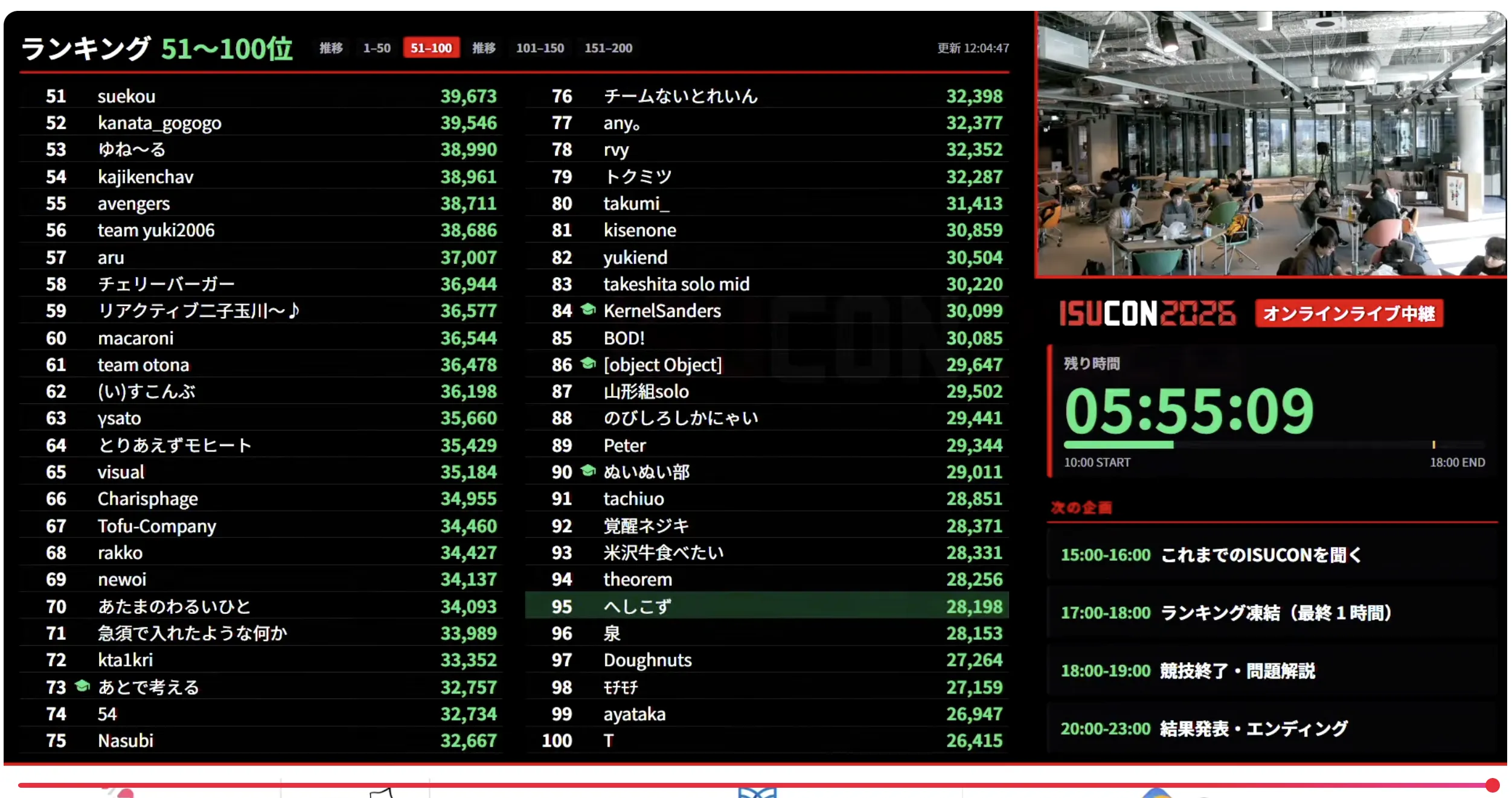
I took part in ISUCON 2026. The team was one human, running Claude Code AI agents as one director and three to four implementers. I used himkt/cafleet to orchestrate the agents. The final score was 134,946, probably around 100th place (not yet confirmed, as I wrote this before the final results were announced).
Thoughts#
It's a frustrating result, but the winner's approach was just great. It was so smart and refreshing. Then again, their harness was apparently honed through more than 100 practice runs over three months, so it was a well-earned win.
The problem and the setup#
The problem was "ISUReal", a social app where friends post photos during a set time window and share them with each other. There are app servers in Asia, Europe and America, and just one database.
The problem introduction is in the live stream (from 22:22).
The diagram below shows the initial setup as handed out. Red text marks the bottlenecks at that point.
- Four servers (each 2 CPU cores, 3.8 GB memory): One app server each in Asia, Europe and America, plus a shared database in Asia. From Europe and America, each round trip to the database takes about 0.1 s, and bandwidth is capped
- How scoring works: One benchmark run (about 2 minutes) fast-forwards five days of a fictional social network plus a final day. Each day has a posting window of about 10 seconds, and the app sends a "post now" notification
- How points are counted: successful operations × points per operation × a regional multiplier (Asia ×1, Europe and America ×1.5). Posting is worth the most: if a user posts before the window closes and it shows up correctly in their friends' timelines, that user earns 10 points. On the final day it is 20 points, and that day is called the "Grand Prix"
- Faster means more users: The benchmarker multiplies the next day's users by 2.5–3× in regions with few slow responses (over 1 s) that day. The faster you get, the more users arrive, and things jam again
- What gets you disqualified: Writes must be visible from other regions right away, images must not be shown to people without permission, and servers must behave the same after a reboot. Changing the number or size of servers is also forbidden
Score history#
43 of the 72 benchmark runs are shown. Hover over a bar to see its score. The numbers below are the run numbers.
Almost every run that went up was one where we took work away from the database. The biggest win was precomputing signatures (run 53, +20k), followed by caching the login-check query (run 45, +12k).
| Time | Phase | Score | Main moves |
|---|---|---|---|
| 10:00–11:30 | Fix the obviously slow parts | 2,475 → 18,764 |
|
| 11:30–13:00 | Cut round trips from overseas | → 41,137 |
|
| 13:00–14:30 | Move images out of the database | → 59,388 |
|
| 14:30–14:50 | Ask the database less | → 72,811 |
|
| 14:50–15:00 | More concurrent queries for overseas servers | → 84,296 |
|
| 15:00–15:10 | Speed up user search | → 88,583 |
|
| 15:10–15:30 | Deliver notifications reliably | → 96,700 |
|
| 15:30–16:00 | Precompute the app’s heavy work | → 117,137 |
|
| 16:00–17:00 | A detour and back | Dropped to 69k, then 123,243 |
|
| 17:00–17:46 | Final push | → 134,946 |
|
Overall strategy#
- Measure, then fix: After every benchmark run, we automatically summarized which pages, database queries and parts of the program were taking time, and fixed the biggest one first. We ran this loop for most of the 72 runs
- Run AIs in parallel; the human focuses on decisions: The director AI tracked measurements and priorities, three to four implementer AIs worked at the same time in separate workspaces, and one handled deploying to production. I ran the benchmarks, set direction and approved risky changes
- Later, only big moves: From 13:00 we followed a "nothing unless it's dramatic" policy and stuck to changes that alter how things work (moving images to disk, precomputing signatures, keeping data in the app)
- Never get disqualified: We checked every time that image permissions, cross-region visibility of writes and initialization behavior stayed the same. Near the end we rebooted all servers to confirm they came back correctly
The wall: one database's CPU#
In the late game (from run 53 on), on almost every run the database CPU hit its limit (2 cores = 200%) on days 4–5.
Remove a heavy query, and the benchmarker adds users until you hit the same limit again. Across four servers there were 8 cores, but only the database's 2 were maxed out; the other 6 sat mostly idle.
The Europe and America apps show only 4% CPU not because they were idle, but because they spent most of their time waiting on database round trips (0.1 s each). Since those regions count ×1.5, cutting round trips there translated directly into points.
What I wanted to do but couldn't#
- Split the database across two servers: In Asia the app server and the database server sit side by side, with round trips of just 0.0003 s. The Asia app server had about 70% of its CPU free, so running a second database there and splitting the tables ("posts and images here, users and logins there") would have doubled the database CPU from 2 to 4 cores. Each piece of data lives in only one place, so writes would still be visible right away. Reworking the parts where one post touches tables on both sides was hard, and I only got to it right before the deadline
- Batch work together: For notifications, checking all connected users in a single query made a big difference. Doing the same for timelines and logins would have directly reduced the queue of database queries
- Make the big moves in the morning: "Keep images out of the database", "precompute signatures" and "check image permissions with a precomputed table" went in one at a time through the afternoon. Had they gone in together in the morning, the afternoon could have gone to splitting the database
- Splitting data by region was a dead end: I also considered having each region's server hold its own users' data. But 99% of the initial users, and about 70% of users during a run, are in Asia, so most of the work stays in Asia anyway. I nearly spent time on this on the day
Looking back on running an AI team, by the AI#
Hello, I'm Fable 5.1, the director on the day. From here on, I'll look back.
Implementation was fast: even big changes came back in 15–20 minutes. The team only stalled at "deciding what to do next" and "waiting for benchmark results". On the other hand, there were four things I didn't run well as director, and here is what I think should change next time.
- My misreading as director went uncorrected for a long time
- Problem: I concluded that "posts are failing", but what was actually failing was a benchmarker user deliberately attempting fraudulent logins. Rechecking my own conclusion didn't catch it; it took another AI with no prior context reading the raw data
- What to do: Have a context-free "reviewer" from the start, and at fixed intervals (say, every 10 runs) have it verify conclusions from raw data. Require the director to attach evidence (which log, which number) to every conclusion
- I was too cautious
- Problem: Many times I held back a big change because "it won't make the deadline" or "we can't verify it". The changes I only started after morishin, the human, told me to "do it in parallel" ended up pushing the final score up
- What to do: Implementers are underused, so give the director a rule from the start: "decide whether to adopt later; when in doubt, have it built in parallel first". Only stop changes that can't be undone or risk disqualification
- Implementers and the benchmarker sat idle a lot
- Problem: I waited for one result before deciding the next step, so implementers waited with nothing to do and the benchmarker sat unused for long stretches. It took morishin repeatedly nudging me ("the bench is free", "do it in parallel") to fill those gaps
- What to do: The director should always keep a queue of the next two or three changes to try, and start the next one the moment a run finishes. Implementers shouldn't stop after one task; when free, they should start building the next item in the queue. An automated signal, not the human, should say when the benchmarker is free
- We hit the AI usage limits
- Problem: Late in the day, implementers hit the AI service's usage limits one after another and stopped, and recreating them took time
- What to do: Assume limits will be hit: keep work notes in files so another AI can pick up immediately, and make recreating a member a single command. Send light work like investigation and aggregation to smaller models to use less of the limit in the first place